Improve Visibility, Recurring Revenue Operations, and Scalability in Subscription-Based Businesses
BAGE Consulting helps SaaS and subscription-based businesses streamline
operations, automate recurring workflows, and implement systems that support
how their business actually runs — from lead generation and subscription
management to billing, renewals, and financial reporting.
Book Your Free Consultation Explore Solutions

Does Your
Subscription Business Feel
Harder To Manage As You Grow?
Subscription businesses are designed to create recurring revenue and operational efficiency.
But as customer volume, products, billing complexity, and internal workflows grow, many businesses
begin experiencing the opposite: more manual work, more operational complexity, and less visibility.
Subscription Billing and Renewals Require Too Much Manual Work
Managing recurring invoices, failed payments, renewals, upgrades, downgrades, and customer changes manually creates inefficiencies and increases operational risk.
Customer Information Is Spread Across Multiple Systems
Reservations, purchasing, staffing, scheduling, and operational communication are often managed through disconnected systems and manual workflows.
Reporting and Revenue Visibility Are Limited
Without connected systems, it becomes difficult to accurately track:
- Monthly recurring revenue (MRR)
- Customer churn
- Customer lifetime value (LTV)
- Renewal performance
- Subscription profitability
Growth Creates More Complexity Instead of More Efficiency
As subscriptions increase, operational processes become harder to manage — making the business feel reactive instead of scalable.
Customer Onboarding and Service Delivery Are Inconsistent
Without structured workflows, onboarding experiences vary between customers — creating delays, communication gaps, and operational inefficiencies.
Teams Spend Time Managing Systems Instead of Customers
Manual updates, spreadsheets, disconnected workflows, and duplicate data entry consume time that should be focused on growth and customer success.
Why Subscription Businesses Become Operationally Fragmented
Most subscription-based businesses don’t struggle because of their product or service.
They struggle because the systems and processes supporting recurring operations are disconnected.
Over time, businesses add tools to solve individual problems:
A CRM for sales
Software for billing
Separate tools for support
Spreadsheets for reporting
Manual workflows to connect everything together
While each system may solve a specific need, the business itself becomes increasingly fragmented.
 Disconnected Customer and Operational Data
Critical information lives across multiple systems, making it difficult to get accurate visibility into customers, subscriptions, financials, and operations.
 Inconsistent Customer Experiences
When onboarding, communication, billing, and support processes are not standardized, customer experience becomes inconsistent and difficult to scale.
This is not simply a software problem — it’s
an operational structure problem.
 Manual Operational Workarounds
Teams rely on spreadsheets, manual updates, and internal workarounds to manage recurring workflows that should be automated.
 Limited Financial and Operational Visibility
Without connected systems, reporting becomes delayed, fragmented, and unreliable — making strategic decision-making more difficult.
 Processes Depend on Individuals Instead of Systems
Operational knowledge often exists within specific employees rather than within structured workflows and systems.
Solutions Built Around
How
Subscription
Business Operates
Every subscription-based business operates differently.
Whether you’re managing SaaS subscriptions, recurring services, memberships, retainers, or usage-based billing, your systems should support how your business actually works.
We implement connected solutions that improve visibility, automation, operational efficiency, and recurring revenue management.

CRM & Sales Pipeline Management
Track leads, manage opportunities, automate follow-ups, and improve conversion through a structured customer acquisition process.

Subscription & Recurring Billing Management
Manage recurring invoices, renewals, upgrades, downgrades, pricing plans, and payment collection within one connected system.

Customer Onboarding & Account Management
Standardize onboarding workflows, automate customer setup, and improve customer experience across the entire lifecycle.

Project Management & Service Delivery
Manage implementation projects, customer requests, internal tasks, and operational workflows with real-time visibility and accountability.

Reporting & Real-Time Dashboards
Monitor operational performance, subscription metrics, customer activity, and financial KPIs through connected dashboards and reporting systems.

Customer Support & Ticket Management
Centralize customer communication, support requests, issue tracking, and service delivery processes.

Workflow Automation & Approval Processes
Reduce manual work through automated workflows for billing, onboarding, approvals, notifications, and customer communication.

Accounting & Financial Reporting
Track recurring revenue, financial performance, invoicing, profitability, and operational metrics with accurate real-time reporting.
The Right Platform to Support
Recurring Revenue Operations
Once the right processes are clearly defined, the systems supporting them become critical.
We work with Odoo because it provides a flexible, scalable platform that aligns with how subscription-based businesses actually operate.
Instead of forcing your business into rigid workflows, Odoo adapts to your operations — supporting recurring revenue processes, customer lifecycle management, automation, and long-term scalability.
As an open-source ERP platform, Odoo provides the flexibility needed to evolve alongside growing subscription businesses.
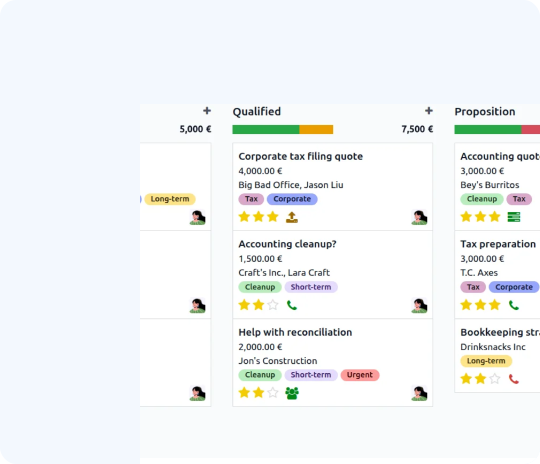
Manage Sales, Billing, and Operations in One System
Connect CRM, subscriptions, invoicing, customer management, reporting, and operational workflows within one integrated platform.
Flexible & Open-Source by Design
Odoo can be configured around your business model, pricing structures, customer workflows, and operational requirements.
Automate Recurring Revenue Operations
Reduce manual work through automated:
- recurring invoices
- payment collection
- subscription renewals
- onboarding workflows
- notifications and approvals
Real-Time Visibility Across Your Business
Access live dashboards and reporting across:
- recurring revenue
- customer performance
- financials
- operations
- subscription metrics
Start Small and Scale Over Time
Implement the functionality you need today — and expand your system as your business evolves without replacing your infrastructure.
Why Subscription
Businesses Choose BAGE Consulting
Implementing ERP systems in subscription-based businesses requires more than technical setup.
It requires understanding how recurring revenue businesses operate, how customer lifecycles function, and how operational processes connect across the organization.
That’s where BAGE Consulting takes a different approach.
We don’t just implement software — we help subscription businesses build scalable, process-driven operations.
Official Odoo Partner
In Canada
As an official Odoo partner in Canada, we help businesses implement flexible ERP systems aligned with Canadian business operations and reporting requirements.
Business & Financial Systems
Expertise
Beyond software implementation, we understand how operational and financial processes connect — helping businesses improve visibility, reporting, and scalability.
Process-First Consulting Approach
We focus on understanding how your business operates before implementing any system — ensuring technology supports operational efficiency instead of creating more complexity.
Experience With Connected Operational Workflows
We understand how sales, onboarding, subscriptions, support, billing, and financial reporting work together within recurring revenue businesses
Structured Implementation & Long-Term Support
From discovery and process mapping to implementation, training, go-live, and optimization — we support your business through every stage.

Systems Designed To Support Growth
We help businesses build operational foundations that support sustainable growth without increasing complexity.
long term.
Frequently Asked Questions
What’s the best ERP software for subscription-based businesses?
The best ERP software for subscription-based businesses is one that can connect recurring billing, customer management, financial reporting, onboarding, and operational workflows within one system.
Many subscription businesses struggle because their CRM, billing, accounting, and support tools operate separately.
Odoo is one of the best ERP platforms for subscription-based businesses because it provides:
- Subscription and recurring billing management
- CRM and customer lifecycle management
- Financial reporting and accounting
- Workflow automation
- Customer support and project management
- Real-time operational visibility
Its modular, open-source structure also makes it flexible enough to adapt to different subscription business models.
What’s the best ERP software for SaaS businesses?
The best ERP software for SaaS businesses is one that supports scalability, automation, recurring revenue management, and operational visibility.
SaaS businesses typically require systems that can manage:
- Sales pipelines
- Customer onboarding
- Subscription billing
- Customer support
- Financial reporting
- Renewal and retention workflows
Odoo is often a strong fit for SaaS companies because it combines these functions into one connected platform — eliminating the need for multiple disconnected systems.
Its open-source architecture also allows businesses to customize workflows as operations evolve.
How much does ERP implementation cost for subscription-based businesses?
ERP implementation costs vary depending on:
- Business complexity
- Number of users
- Modules required
- Level of customization
- Integrations needed
- Data migration requirements
For subscription-based businesses, implementation often includes:
- CRM setup
- Subscription billing configuration
- Financial reporting
- Workflow automation
- Customer lifecycle management
- System integrations
The real value of ERP implementation comes from improving operational efficiency, automation, visibility, and scalability — not simply installing software.
At BAGE Consulting, we focus on implementing only the functionality your business actually needs, helping reduce unnecessary complexity and cost.
Why do SaaS and subscription businesses outgrow disconnected systems?
As subscription businesses grow, operational complexity increases rapidly.
Many businesses start with separate tools for:
- CRM
- Billing
- Accounting
- Support
- Reporting
- Project management
Over time, these disconnected systems create:
- Duplicate work
- Data inconsistencies
- Limited visibility
- Manual operational processes
- Reporting challenges
ERP systems like Odoo help unify these operations into one connected platform — improving scalability and operational control
Can Odoo handle recurring billing and subscription management?
Yes.
Odoo includes subscription management functionality that supports:
- Recurring invoicing
- Automated renewals
- Payment tracking
- Pricing plans
- Customer subscriptions
- Revenue visibility
Because Odoo is modular and open-source, subscription workflows can also be customized around how your business operates.
This makes it well-suited for SaaS companies, recurring service providers, memberships, and other subscription-based business models
Is Odoo good for SaaS businesses?
Yes.
Odoo is a strong ERP option for SaaS businesses because it combines:
- CRM
- subscriptions
- accounting
- project management
- customer support
- automation
- reporting
within one connected platform.
Instead of managing operations across multiple disconnected tools, SaaS businesses can centralize operations and improve visibility across the customer lifecycle.
Its scalability also makes it suitable for growing businesses
What processes should ERP improve in a subscription business?
ERP systems should improve the core workflows that drive recurring revenue businesses, including:
- Lead-to-order (L2O)
- Customer onboarding
- Subscription management
- Order-to-cash (O2C)
- Customer support
- Renewal management
- Record-to-report (R2R)
When these processes are standardized and connected, businesses improve operational efficiency, visibility, and scalability.
What is the benefit of a process-first ERP implementation?
A process-first ERP implementation focuses on improving how the business operates before implementing software.
Instead of forcing workflows into rigid systems, businesses first:
- analyze current operations
- identify inefficiencies
- design better workflows
- align systems around business processes
This leads to:
- better system adoption
- improved operational efficiency
- stronger scalability
- reduced implementation failure risk
At BAGE Consulting, process design is a core part of every ERP implementation.
Can Odoo integrate with existing SaaS tools and platforms?
Yes.
Odoo can integrate with:
- payment processors
- accounting platforms
- CRM systems
- support platforms
- ecommerce systems
- marketing tools
- third-party applications
This allows businesses to improve operational connectivity without needing to replace every system immediately.
Is Odoo scalable for growing subscription businesses?
Yes.
Odoo is designed to scale alongside your business.
Subscription businesses can start with core functionality such as:
- CRM
- subscriptions
- invoicing
- reporting
and expand into additional modules as operations evolve.
Because Odoo is modular and open-source, businesses can continue improving and expanding their systems without rebuilding their entire infrastructure.
Why do ERP implementations fail in SaaS businesses?
Many ERP implementations fail because businesses focus on software before understanding operational workflows.
Without clearly defined processes:
- systems become difficult to adopt
- workflows remain inconsistent
- automation opportunities are missed
- reporting stays fragmented
Successful ERP implementation requires aligning technology with how the business should operate.
That’s why process mapping and operational design are critical before implementation begins.
What should businesses look for in an ERP implementation partner?
Businesses should look for an ERP partner that understands:
- business operations
- financial workflows
- process design
- change management
- system integration
- long-term scalability
The right partner should focus on improving how the business operates — not simply installing software.
As an official Odoo partner in Canada, BAGE Consulting combines business consulting, process improvement, and ERP implementation into one structured approach
Start The Conversation
If your subscription business feels more operationally complex than it should, we’ll help you
identify where processes, systems, and workflows can be improved.