Improve Property Visibility, Operational Control, and Financial Oversight
BAGE Consulting helps real estate businesses streamline operations, improve property visibility, and implement systems that support how their business actually operates — from property management and lease tracking to maintenance coordination, procurement, tenant communication, and financial reporting.

Does Your Real Estate Business Feel More
Difficult To Manage As You Grow?
As properties, tenants, projects, vendors, and operational responsibilities increase, many real estate businesses struggle
with disconnected systems, inconsistent workflows, and limited operational visibility.
Without connected processes and centralized systems, growth often creates more operational complexity instead of more efficiency.
Property Information
Is Disconnected
Lease data, maintenance records, financials, vendor information, and tenant communication often exist across multiple systems and spreadsheets.
Processes Vary Across Properties Or Teams
Without standardized workflows, property management operations become inconsistent across locations, staff, and vendors.
Maintenance & Operational Requests Are Difficult To Track
Maintenance coordination, approvals, vendor communication, and service tracking are often handled manually — creating delays and inconsistencies.
Reporting Is Delayed
Or Incomplete
Operational and financial reporting across properties, maintenance, procurement, and lease management is often fragmented or outdated.
Financial Visibility Across Properties Is Limited
Businesses struggle to access accurate, real-time visibility into property performance, operational costs, lease revenue, and profitability.
Growth Creates More Administrative Complexity
As the business expands, disconnected systems and manual coordination become harder to manage and scale.
Why Real Estate Operations Become Fragmented
Most real estate businesses don’t struggle because of demand — they struggle because operational workflows and systems are disconnected.
Over time, businesses often add separate tools for:
property management
accounting
maintenance coordination
lease tracking
procurement
tenant communication
vendor management
reporting
While each tool may solve one operational need, the overall business becomes increasingly fragmented
 Limited Visibility Across Properties And Operations
Property operations, maintenance activity, procurement, tenant management, and financial reporting operate separately — making oversight difficult.
This is not simply a technology issue — it’s an operational process and visibility problem.
 Manual Coordination Across Teams And Vendors
Teams rely on spreadsheets, emails, phone calls, and disconnected systems to manage operational workflows.
 Scaling Becomes More Operationally Difficult
As more properties, tenants, vendors, and operational demands are added, disconnected systems create more complexity and administrative overhead
 Delayed Operational And Financial Reporting
Without connected systems, businesses struggle to access accurate real-time information across operations
 Inconsistent Property Management Processes
Maintenance handling, approvals, procurement, communication, and reporting workflows vary across teams and properties
Solutions Built Around How
Real Estate Businesses Operates
Real estate businesses require connected systems that support property management, maintenance
coordination, procurement, financial reporting, tenant communication, and operational visibility.
We implement solutions designed around how real estate operations actually function.

Property & Lease Management
Manage property information, lease tracking, tenant workflows, renewals, operational visibility, and revenue management through one connected system.

Maintenance & Service Request Management
Track maintenance requests, approvals, vendor coordination, service completion, and operational accountability.

Procurement & Vendor Management
Manage purchasing workflows, approvals, supplier coordination, contractor management, and procurement visibility.

Accounting & Financial Reporting
Connect operational and financial workflows for accurate reporting, profitability visibility, invoicing, and financial oversight across properties.

Workflow Automation & Operational Approvals
Reduce manual work through automated maintenance approvals, notifications, procurement workflows, and operational processes.

Reporting & Operational Dashboards
Monitor lease activity, property performance, operational costs, maintenance activity, and financial KPIs in real time.

Document Management & Internal Coordination
Centralize property records, lease agreements, vendor documentation, operational policies, and internal communication processes.

CRM & Tenant Relationship Management
Manage tenant communication, inquiries, lease opportunities, onboarding, and customer relationship workflows.
The Right Platform to Support
Real Estate Operations
Once the right operational processes are clearly defined, the systems supporting them become critical.
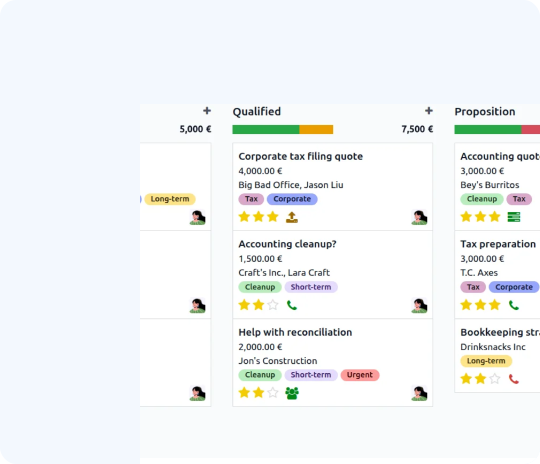
We work with Odoo because it provides a flexible, scalable platform that aligns with how real estate businesses actually operate.
Instead of forcing businesses into rigid workflows, Odoo adapts to your property management operations, maintenance coordination, procurement processes, financial workflows, and reporting requirements.
As an open-source ERP platform, Odoo provides the flexibility real estate businesses need to improve operational efficiency and scale effectively..
Scale Operations Without Replacing Systems
Start with the functionality you need today and expand your system as your real estate operations evolve.
Improve Property Visibility & Operational Coordination
Manage properties, maintenance requests, vendors, lease activity, procurement, and reporting through connected systems.
Connect Property Operations, Financials, And Reporting In One System
Bring operational workflows together into one connected platform with shared, real-time visibility.
Real-Time Reporting Across Operations
Access dashboards and reporting across property performance, lease revenue, operational costs, maintenance activity, and financial performance.
Flexible & Open-Source By Design
Configure workflows, approvals, maintenance operations, procurement processes, and reporting around how your business actually operates.
Why
Real Estate Organizations Choose
BAGE Consulting
Successful ERP implementation in real estate businesses requires more than software setup.
It requires understanding how property operations, maintenance workflows, procurement, tenant management, financial reporting, and operational coordination connect across the business.
That’s where BAGE Consulting takes a different approach.
We don’t just implement ERP systems — we help real estate businesses build more connected, scalable operations.
Official Odoo Partner
In Canada
As an official Odoo partner in Canada, we help real estate businesses implement flexible ERP systems aligned with Canadian operational and reporting requirements
Business & Financial Systems Knowledge
We align operational workflows with accurate reporting, profitability visibility, invoicing, and business performance tracking.
Process-First Consulting Approach
We focus on improving how your real estate business operates before implementing any system — ensuring long-term operational efficiency and scalability.
Real Estate Operational Workflow Expertise
We understand how lease management, maintenance operations, procurement, vendor coordination, and financial reporting connect across property operations

Systems Designed
To Support Growth
We help real estate businesses build operational foundations that improve efficiency, visibility, and scalability over the long term.
Structured Implementation & Long-Term Support
From process mapping and implementation to training, go-live, and ongoing optimization — we support businesses through every stage.
Frequently Asked Questions
What Is ERP For Real Estate Businesses?
ERP (Enterprise Resource Planning) for real estate businesses is a connected system that helps manage operational workflows such as:
- property management
- lease tracking
- maintenance coordination
- procurement
- tenant communication
- invoicing
- financial reporting
Instead of operating through disconnected systems and spreadsheets, ERP platforms centralize operations into one connected environment — improving visibility, efficiency, and operational control.
How Is ERP Used In Real Estate Businesses?
ERP systems are used to connect operational workflows across property management, maintenance coordination, procurement, vendor management, tenant communication, and financial reporting.
Real estate businesses use ERP systems to:
- manage lease operations
- track maintenance requests
- improve procurement visibility
- centralize operational reporting
- monitor property performance
- improve financial oversight
- automate workflows
This helps businesses improve operational efficiency, reduce manual coordination, and scale more effectively.
What Is The Best ERP Software For Real Estate Companies?
The best ERP software for real estate companies is one that supports:
- property operations
- maintenance management
- procurement
- accounting
- lease tracking
- reporting
- workflow automation
Odoo is a strong ERP platform for real estate businesses because it combines operations, procurement, CRM, accounting, reporting, and workflow management into one connected system.
Its open-source architecture also makes it flexible for different real estate operational workflows.
Can ERP Improve Property Management Operations?
Yes.
ERP systems improve property management operations by providing:
- real-time property visibility
- maintenance tracking
- lease management
- operational coordination
- vendor management
- centralized reporting
- workflow automation
This helps businesses improve operational consistency, response times, and property oversight
Why Do Real Estate ERP Implementations Fail?
Many real estate ERP implementations fail because businesses focus on software before improving operational workflows.
Without clearly defined processes:
- maintenance coordination remains inconsistent
- reporting stays fragmented
- procurement visibility is limited
- operational inefficiencies continue
A process-first ERP implementation approach helps ensure systems support how real estate operations should function.
Is Odoo Good For Real Estate Businesses?
Yes.
Odoo is well-suited for real estate businesses because it supports:
- property management
- procurement
- CRM
- accounting
- reporting
- maintenance workflows
- operational automation
within one connected platform.
Its modular and open-source structure allows businesses to configure workflows around their operational requirements.
Can Odoo Integrate With Existing Real Estate Systems?
Yes.
Odoo can integrate with:
- accounting software
- payment processors
- CRM platforms
- document management tools
- tenant communication systems
- third-party operational software
This allows businesses to improve operational connectivity without replacing every existing system immediately
What Processes Should ERP Improve In Real Estate Businesses?
ERP systems should improve key end-to-end business processes such as:
- Lead-to-Lease
- Maintenance-to-Resolution
- Procure-to-Pay (P2P)
- Property-to-Revenue
- Vendor Management
- Record-to-Report (R2R)
When these workflows are connected and standardized, real estate businesses improve operational efficiency, visibility, and scalability.
How Much Does ERP Implementation Cost For Real Estate Businesses?
ERP implementation costs vary depending on:
- number of properties
- operational complexity
- integrations
- customization requirements
- number of users
Real estate ERP implementation often includes:
- property management workflows
- procurement automation
- reporting dashboards
- maintenance workflows
- financial system integration
The real value comes from improving operational visibility, coordination, reporting, and scalability.
What Should Real Estate Businesses Look For In An ERP Partner?
Real estate businesses should look for an ERP partner that understands:
- property operations
- maintenance workflows
- procurement
- financial reporting
- operational coordination
- workflow standardization
The right implementation partner should focus on improving how the business operates — not simply installing software.
As an official Odoo partner in Canada, BAGE Consulting combines operational consulting, process improvement, and ERP implementation into one structured approach.
What Is The ERP System In Real Estate?
An ERP system in real estate is a connected platform that helps businesses manage property operations, lease management, maintenance workflows, procurement, tenant communication, accounting, and financial reporting within one system.
Instead of managing operations across multiple disconnected tools, real estate ERP systems centralize operational and financial workflows into one connected environment.
Real estate businesses use ERP systems to:
- track property performance
- manage lease agreements
- coordinate maintenance requests
- manage vendors and procurement
- automate invoicing and payment tracking
- improve operational reporting
- gain real-time financial visibility
ERP systems help real estate businesses improve operational efficiency, reduce manual coordination, and scale property operations more effectively.
Odoo is a strong ERP platform for real estate businesses because it combines operational workflows, CRM, accounting, reporting, procurement, and workflow automation into one flexible, open-source system.
Start The Conversation
If property management, maintenance coordination, procurement, and operational visibility feel harder to manage than they should, it may be time for a more connected approach.
We’ll help you identify operational inefficiencies, improve visibility across your properties, and implement systems that support scalable real estate operations.