
Improve Project Visibility,
Cost Control, and Operational
Efficiency in Construction Businesses
BAGE Consulting helps construction companies streamline operations, improve
project visibility, and implement systems that support how their business
actually runs — from estimating and job costing to project delivery and
cash collection.
Book Your Free Consultation Explore Solutions
Does Your Business Feel More
Complicated Than It Should?
As projects grow and teams expand, operations often become harder to manage — not because of your people,
but because processes aren’t clearly defined or supported by the right systems.
Work Depends on
Key Individuals
Critical knowledge lives in people’s heads rather than in structured processes — creating bottlenecks and risks when someone is unavailable.
Processes Are Inconsistent Across Projects
Each project is managed differently, leading to delays, errors, and rework.
Project Costs Are
Hard to Track
You know margins are tight, but lack clear visibility into job costing, labour, and materials across projects.
Lack of Real-Time Visibility
By the time you get reports, the data is already outdated — making it hard to make timely decisions.
Information Is Scattered Across Tools
Spreadsheets, emails, accounting software, and site updates aren’t connected — making it difficult to get a clear picture of operations.
Growth Creates More Pressure, Not Progress
As project volume increases, inefficiencies become more visible — making the business harder to manage instead of easier.
Why Construction Operations Become Difficult as You Grow
Most construction businesses don’t struggle because of their people — they struggle because their processes aren’t clearly defined or connected. Without this, even the best teams struggle to stay aligned as complexity increases.
This isn’t a software problem — it’s a process problem.
And that’s where real improvement starts
 No Defined End-to-End Processes
From lead to project completion to payment, workflows are often fragmented — leading to missed steps, delays, and inefficiencies.
 Disconnected Systems and Tools
Estimating, project management, accounting, and communication tools operate separately — creating gaps in data and visibility.
 Knowledge Is Trapped in People, Not Processes
When workflows rely on experience instead of structure, consistency becomes difficult and scaling becomes risky.
 Lack of Process Visibility and Accountability
Without clearly mapped workflows, it’s hard to track progress, identify bottlenecks, or ensure accountability across teams
Solutions Built Around
How Your Business Operates
Whether you're looking to improve sales processes, manage projects more effectively, or gain better visibility into
operations, we help implement the right systems to support your workflows.

CRM & Sales
Pipeline Management
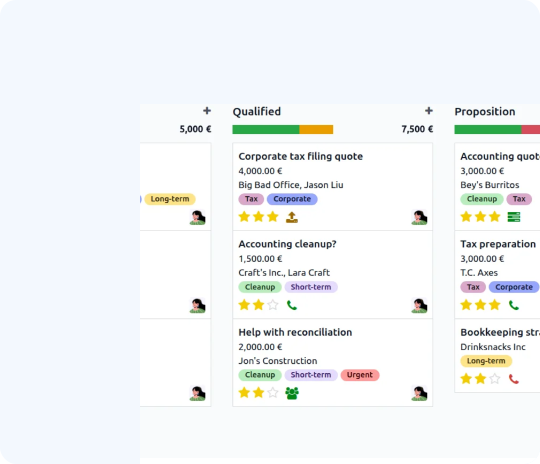
Track leads, manage estimates, and convert prospects into clients with a structured sales process.

Project Management
& Delivery
Plan, track, and manage projects with clear timelines, task accountability, and real-time updates.

Job Costing
& Financial Visibility
Understand project profitability, control costs, and improve financial insight across all jobs.

Inventory &
Materials
Management
Track materials, manage purchasing, and ensure the right resources are available when needed.

Workflow Automation & Approvals
Reduce manual work with automated workflows for approvals, tasks, and communication.

Document Management & Communication
Keep all project documents, communications, and files organized and accessible in one place.

Accounting & Financial Reporting
Integrate financials with operations to gain accurate, real-time reporting and insights

Work Order & Field Operations Management
Coordinate teams, manage job execution, and track work orders across sites and projects.
The Right Platform to Support
Better Business Processes
Once the right processes are in place, the systems supporting them become critical.
We work with Odoo because it provides a flexible, scalable platform that aligns with how your business operates — rather than forcing your business into rigid structures.
As an open-source ERP, Odoo can be configured and customized to support your workflows, ensuring your processes remain efficient as your business grows.
Start Where It Matters Most
Implement the areas that create the most impact first — whether that’s project management, job costing, or financial visibility — and expand as your needs grow.
One Connected Platform Across Your Business
Bring your sales, operations, projects, and financials into one system — eliminating disconnected tools and improving data consistency.
Scalable as Your Business Grows
Expand your system as your business evolves — without needing to replace or rebuild your infrastructure.
Flexible & Open-Source by Design
As an open-source platform, Odoo can be configured to support how your construction business actually operates — not force you into rigid workflows.
Real-Time Visibility Across Operations
Access up-to-date data across projects, costs, and performance — enabling better, faster decision-making.
Why Businesses Choose
BAGE Consulting
I Successful ERP implementation is not just about selecting the right software — it’s about understanding how your business operates and building the right processes to support it.
Built for Canadian Construction Businesses
We understand Canadian tax requirements, business structures, and industry workflows — ensuring your system works in practice, not just in theory.
Accounting & Financial Systems Knowledge.
With strong expertise in accounting and financial operations, we ensure your systems provide accurate reporting, cost control, and compliance.
Process-First Consulting Approach
We focus on how your business works before implementing any system — ensuring long-term efficiency and scalability.
Business Process & Operational Expertise
We understand how workflows connect across estimating, project delivery, procurement, and financials — not just how software works.
Structured Implementation & Ongoing Support
From process design to post-go-
live support, we guide your business through every stage — ensuring adoption and long-term success.

Frequently Asked Questions
What is ERP for construction companies?
ERP for construction companies is a system that connects core business processes — including project management, job costing, procurement, and financial reporting — into one integrated platform. When implemented correctly, it improves visibility, efficiency, and control across operations.
How can ERP improve construction project management?
ERP systems improve construction project management by centralizing project data, standardizing workflows, and providing real-time visibility into timelines, costs, and progress. This helps reduce delays, improve coordination, and ensure projects stay on track.
.
Why do construction ERP implementations fail?
Most ERP implementations fail because they focus on software before addressing how the business operates. Without clearly defined processes, even the best systems cannot deliver value. A process-first approach ensures the system supports efficient workflows.
What are the key processes in a construction business?
Key processes in construction businesses include lead-to-order (L2O), order-to-cash (O2C), procure-to-pay (P2P), and project delivery. These end-to-end workflows define how work flows through the business and directly impact efficiency and profitability.
How long does it take to implement an ERP system in construction?
ERP implementation timelines vary depending on complexity, but most projects are delivered in phases. A structured approach — including process review, system configuration, training, and go-live support — ensures a smoother and more effective rollout
.
Can ERP systems handle job costing in construction?
Yes, ERP systems can track job costs in real time, including labour, materials, and overhead. This improves cost control, project profitability, and financial visibility across all jobs.
Is Odoo suitable for construction companies?
Yes, Odoo is well-suited for construction companies because it is an open-source ERP platform that can be customized to support project management, job costing, procurement, and financial workflows specific to the industry.
What is the benefit of a process-first ERP implementation?
A process-first ERP implementation ensures that systems are designed around how your business should operate. This leads to better adoption, improved efficiency, and long-term scalability compared to software-first implementations.
Can ERP systems integrate with existing construction tools?
Yes, ERP systems like Odoo can integrate with existing tools such as accounting software, project management platforms, and third-party applications — creating a more connected and efficient business environment.
What happens after ERP implementation?
After implementation, businesses go through testing, training, and go-live phases, followed by ongoing support and optimization. Continuous improvement ensures the system evolves with the business and continues to deliver value.
Start Improving Your
Construction Operations
If your projects feel harder to manage than they should, it may be time to take a more structured approach.
We’ll help you understand how your business operates today, identify where improvements can be made, and guide you toward a more efficient, scalable way of working.