Improve Client Management, Delivery Efficiency, and Revenue Visibility in Professional Service Businesses
BAGE Consulting helps professional service firms streamline operations, improve client and project visibility, and implement systems that support how their business actually runs — from lead generation and client onboarding to project delivery, time tracking, and billing.
Book Your Free Consultation Explore Solutions

Does Your Service Business Feel
More Complicated Than It Should?
As your client base grows and projects become more complex, operations often
become harder to manage — not because of your people, but because processes
aren’t clearly defined or supported by the right systems.
Time Tracking and
Billing Are Misaligned
Billable work is not consistently tracked or connected to invoicing — leading to missed revenue and delays.
Processes Are Inconsistent Across Clients
Each engagement is handled differently, leading to inefficiencies, inconsistent delivery, and reliance on individuals.
Growth Creates More Complexity, Not Efficiency
As you take on more clients, your operations become harder to manage instead of more streamlined.
Work Depends on
Key Individuals
Client knowledge, project context, and communication live in people’s heads — creating bottlenecks and risk when someone is unavailable.
Projects Are Hard to
Track and Manage
You lack clear visibility into project progress, timelines, and team workload across multiple clients.
Client Communication
Is Scattered
Emails, notes, documents, and updates are spread across tools — making it difficult to stay organized and consistent.
Why Service Operations Become Difficult as You Grow
Most professional service businesses don’t struggle because of their people — they struggle because their processes aren’t clearly defined or connected.
Without structured workflows, even experienced teams rely on manual coordination, memory, and workarounds to keep things moving.
As the business grows, these gaps become more visible — and more costly.
 No Defined End-to-End Client Lifecycle
From lead generation to onboarding, project delivery, and billing, workflows are often fragmented. Important steps are missed, responsibilities are unclear, and work is not consistently executed.
This isn’t a software problem — it’s a process problem.
And that’s where real improvement starts.
 Lack of Process Visibility and Accountability
Without clearly mapped workflows and centralized information, it’s difficult to track progress, identify bottlenecks, or ensure accountability across teams and client engagements.
 Knowledge Is Trapped in People, Not Processes
When workflows rely on individual experience instead of structured systems, onboarding new team members becomes difficult, and consistency across projects is hard to maintain.
 Disconnected Systems and Tools
CRM, project management, time tracking, and accounting systems operate independently. This creates duplicated work, inconsistent data, and limited visibility across your operations.
Solutions Built Around
How Your Service
Business Operates
Whether you're looking to improve client management, streamline delivery, or gain better visibility into your operations, we implement the right systems to support your workflows.

CRM & Sales
Pipeline Management
Track leads, manage opportunities, and convert prospects into clients with a structured, visible sales process.

Project Management
&
Service
Delivery
Plan, manage, and track client work with clear timelines, defined responsibilities, and real-time progress visibility.

Time Tracking & Billing Management
Capture billable time accurately and connect it directly to invoicing — ensuring no revenue is missed

Client Onboarding & Workflow Automation
Standardize how new clients are onboarded and automate repetitive tasks to improve efficiency and consistency.
.

Workflow Automation & Approvals
Automate approvals, notifications, and routine workflows to reduce manual work and improve operational consistency.

Document & Communication Management
Centralize client communication, files, and documentation — making information accessible and organized.

Accounting & Financial Reporting
Connect your operations with your financials to gain accurate, real-time visibility into performance and profitability.
The Right Platform to Support
Better Business
Service Processes
Once the right processes are in place, the systems supporting them become critical.
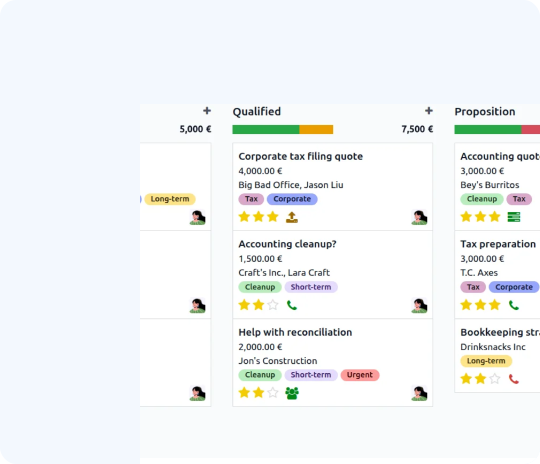
We work with Odoo because it provides a flexible, scalable platform that aligns with how your business operates — rather than forcing your business into rigid structures..
As an official Odoo partner in Canada, BAGE Consulting ensures your system is properly configured, aligned with your processes, and built for long-term success.
Flexible & Open-Source by Design
Odoo is an open-source ERP platform, allowing it to be configured and customized to support your workflows — ensuring your system fits your business, not the other way around.
Start Where It Matters Most
Implement the areas that create the most impact first — such as CRM, project management, or billing — and expand as your needs grow
Scalable as Your Business Grows
Expand your system as your business evolves — without needing to replace or rebuild your infrastructure.
One Connected Platform Across Your Business
Bring your sales, delivery, time tracking, and financials into one system — eliminating disconnected tools and improving data consistency.
Real-Time Visibility Across Operations
Access up-to-date data across clients, projects, and financial performance — enabling faster and more informed decision-making.
Why Professional Service Firms Choose BAGE Consulting
Successful system implementation is not just about selecting the right software — it’s about understanding how your business operates and building the right processes to support it.
We don’t just implement systems — we help you build a business that runs with clarity, structure, and control.
Process-First Consulting Approach
We focus on how your business works before implementing any system — ensuring long-term efficiency, adoption, and scalability.
Business Process & Operational Expertise
We understand how workflows connect across sales, client delivery, billing, and financial reporting — not just how software works.
Structured Implementation & Ongoing Support
From process design to post-go-live support, we guide your business through every stage — ensuring adoption and long-term success.

Accounting & Financial Systems Knowledge.
With strong expertise in accounting and financial operations, we ensure your systems provide accurate reporting, cost control, and compliance.
Built for Canadian Construction Businesses
We understand Canadian tax requirements, business structures, and operational realities — ensuring your system works in practice, not just in theory.
Professional Services FAQs
What is the best CRM for professional service firms?
The best CRM for professional service firms is one that supports the full client lifecycle — from lead tracking to project delivery and billing.
Unlike standalone CRMs, platforms like Odoo CRM integrate with project management, time tracking, and invoicing, allowing service businesses to manage clients and delivery in one system. As an official Odoo partner in Canada, BAGE Consulting ensures the system is aligned with your workflows.
How can professional service firms improve project visibility?
Project visibility improves when all client work, timelines, and updates are managed in a centralized system. By structuring project delivery processes and connecting them to real-time dashboards, businesses can track progress, identify delays early, and make informed decisions
Why do service-based businesses struggle with billing accuracy?
Many service businesses track time, projects, and invoicing in separate systems. This disconnect leads to missed billable hours, delayed invoices, and revenue leakage.
A structured process combined with an integrated system ensures all billable work flows directly into invoicing.
What are the key processes in a professional service business?
Core processes include:
- Lead-to-Order (L2O): Converting prospects into clients
- Project Delivery: Managing client work from onboarding to completion
- Order-to-Cash (O2C): Delivering services and collecting payment
- Record-to-Report (R2R): Financial tracking and reporting
These processes define how work flows through the business.
How can ERP improve service delivery and client management?
ERP systems improve service delivery by standardizing workflows, centralizing information, and providing real-time visibility across clients and projects. This leads to more consistent delivery, better coordination, and improved client experience.
.
Why do professional service firms struggle to scale?
Scaling becomes difficult when operations rely on individuals instead of structured processes. Without standardized workflows and connected systems, adding more clients increases complexity instead of efficiency.
Is Odoo suitable for professional service businesses?
Yes, Odoo is well-suited for professional service firms because it is an open-source ERP platform that can be customized to support CRM, project management, time tracking, and billing workflows. It allows businesses to start small and expand as they grow
How do you standardize client onboarding and delivery?
Standardization starts with defining a clear onboarding and delivery process — outlining each step from client acceptance to project completion. This process is then supported by a system that ensures consistency, accountability, and visibility across all engagements.
Can ERP systems help reduce missed billable time?
Yes. By connecting time tracking directly to project tasks and invoicing, ERP systems ensure that all billable work is captured and billed accurately. This reduces revenue loss and improves financial performance
What happens after implementing a system like Odoo?
After implementation, businesses go through testing, training, and go-live phases, followed by ongoing support and optimization. Continuous improvement ensures the system evolves with your business and continues to support your processes effectively.
Let’s start a conversation
If managing clients, projects, and billing feels more complex than it should, the issue is often not your team — it’s how your processes are structured. We’ll help you understand how your business operates today, identify where inefficiencies exist, and show you how to build a more structured, scalable way of working.